
Business Model Canvas example: Tesla

Tesla sells cars directly to customers, without dealers, and adds software, energy storage and charging on top. Cars are still the largest part of revenue, but energy storage is growing faster. In 2025 Tesla had $94.8 billion in revenue, of which cars were $69.5 billion, and it delivered 1.64 million vehicles.

Direct sales and software · Cars and energy · Updated November 2026

$94.8B
revenue in 2025 (down 3%)
1.64M
vehicles delivered in 2025 (down 9%)
46.7 GWh
energy storage deployed in 2025
1.1M
paying Full Self-Driving customers (about)

The Business Model Canvas of Tesla

Read the canvas from right to left: first who Tesla creates value for and how it earns from them, then what it takes behind the scenes to deliver that.

Key Partners

  • Battery cell and raw material suppliers
  • Utilities and energy project developers
  • Site hosts for Superchargers
  • Chip and component suppliers

Key Activities

  • Designing and building cars in own Gigafactories
  • Developing Full Self-Driving and AI
  • Building and installing energy storage
  • Running the Supercharger network
  • Selling directly, online and in own stores

Key Resources

  • Gigafactories and manufacturing know-how
  • Data from millions of cars on the road
  • Supercharger network (8,182 stations)
  • Brand and software team

Value Propositions

  • Car buyers: electric cars with performance, range and updates over the air
  • Owners: Full Self-Driving and connectivity as paid software
  • Energy customers: Powerwall and Megapack to store and manage power
  • Charging customers: fast and reliable Supercharging

Customer Relationships

  • Direct ordering online and in the app
  • Software updates keep the car improving
  • Service centres and mobile service
  • Project teams for utilities

Channels

  • Website and app
  • Own stores and delivery centres
  • Direct sales for energy projects
  • Supercharger network and app

Customer Segments

  • Car buyers
  • Owners who buy software (Full Self-Driving)
  • Energy customers: homes and utilities
  • Drivers who charge at Superchargers

Cost Structure

  • Cost of vehicles: batteries, materials, factories
  • Investments in factories and AI computing (over $20 billion capex expected in 2026)
  • Research and development
  • Sales, service and charging

Revenue Streams

  • Vehicle sales
  • Software: Full Self-Driving purchases and subscriptions
  • Energy storage sales
  • Charging, service and other services
Filled in by BMC Shift based on public sources. Business Model Canvas: Strategyzer AG, CC BY-SA 3.0.Edit this canvas and download as PDF

Why Tesla’s model works

No dealers, direct contact

Tesla sells online and in its own stores. It owns the customer relationship and the data, and it can change prices quickly. The trade-off is that it has to build its own service network.

The car keeps earning after the sale

Software updates over the air and paid features such as Full Self-Driving turn a one-time sale into recurring revenue. Almost 1.1 million customers pay for Full Self-Driving.

Energy storage grows next to cars

Vehicle revenue fell 10% in 2025, while energy storage kept growing. In the fourth quarter energy storage earned $1.1 billion in profit, up 49%.

The three riskiest assumptions behind this canvas

Every filled-in canvas is a collection of assumptions. These are the three the Tesla model depends on most, each with an experiment to test it.

The Assumptions character of BMC Shift
Desirability

Buyers keep choosing Tesla over rivals

Deliveries fell for the second year in a row, to 1.64 million in 2025, while competitors launch new electric models. The model needs the brand to stay attractive.

How to test it: ask recent buyers and people who chose another brand which three factors decided, and compare Tesla with the closest rival per factor.

Viability

Software and autonomy earn real money

A large part of the expected future value rests on Full Self-Driving, robotaxis and robots. Around 1.1 million customers pay for Full Self-Driving today, and capital spending is expected to exceed $20 billion in 2026.

How to test it: calculate how many paying customers are needed to cover the extra investment, and compare that with the current growth of paying customers.

Feasibility

Autonomous driving works safely at scale

Robotaxis and unsupervised driving depend on technology and on approval by regulators. If that takes longer than planned, the software part of the model grows slower.

How to test it: define the safety and approval milestones per market and track how many are reached each quarter.

Shift question: what if you change one building block?

Tesla keeps shifting weight between its building blocks. Vehicle revenue fell 10% in 2025, while energy storage and services grew. If autonomy works, customer segments, revenue streams and key activities change again, for example with robotaxis where Tesla sells rides instead of cars.

The Shift character of BMC Shift

Discuss with your team or class

  • What happens to the model if software revenue becomes larger than car revenue?
  • Which building blocks change if Tesla sells rides instead of cars?
  • What if drivers of other brands use the Superchargers more than Tesla owners?

What you learn for your own canvas

  • A product can be the entry point to recurring revenue.
  • Selling directly changes the cost structure: no dealer margin, but your own service costs.
  • Look at which block carries the bet on the future and which one carries today’s revenue.

A filled-in canvas is only the beginning

With BMC Shift your team comes up with new ideas, exposes the riskiest assumptions and designs experiments, around one game board. Played by more than 1,000 people in vocational education, universities of applied sciences, universities and strategy teams.
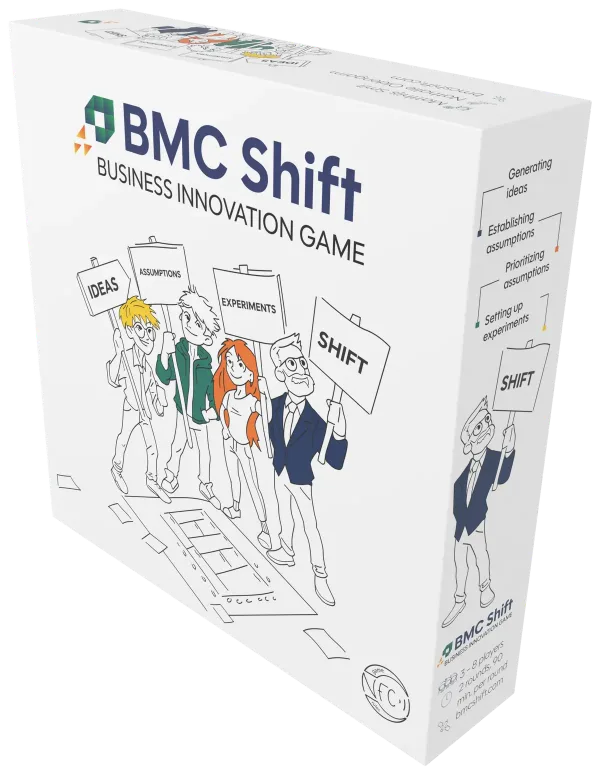
The BMC Shift game box, the board game with the Business Model Canvas

Questions about Tesla’s business model

What is Tesla’s business model?

Tesla designs and builds electric cars and sells them directly to customers, online and in its own stores. On top of that it earns from software such as Full Self-Driving, from energy storage products such as Powerwall and Megapack, and from charging and services.

How does Tesla make money?

Mostly from vehicle sales: $69.5 billion of $94.8 billion revenue in 2025. The rest comes mainly from energy generation and storage and from services and other.

What is Tesla’s biggest cost?

The cost of building cars: batteries, materials and factories. Tesla also spends heavily on factories and AI computing, and expects capital expenditure above $20 billion in 2026.

May I use this example in class or in a workshop?

Yes. Open the example in the free canvas, edit it and download it as a PDF. When you use it, credit BMC Shift as the source and Strategyzer as the creator of the Business Model Canvas.

Sources

  1. Tesla, Fourth Quarter 2025 Production, Deliveries and Deployments (2 January 2026): deliveries, energy storage and Supercharger network.
  2. Yahoo Finance, Tesla revenue slips in 2025 as energy unit grows and vehicle sales fall: revenue by segment.
  3. Yahoo Finance, Tesla Q4 2025 earnings call highlights: Full Self-Driving customers and capital expenditure.
  4. Osterwalder, A. and Pigneur, Y. (2010). Business Model Generation.
Matthijs Smit, founder and creator of BMC Shift
Matthijs Smit is the creator of BMC Shift and a lecturer in entrepreneurship at Hanze University of Applied Sciences. For about ten years he has trained teams, entrepreneurs and teachers in business innovation. LinkedIn

More examples

Ecosystem lock-in

Apple

Devices that open the door and services that earn on every customer.

View the example ›
Lock-in

Nespresso

The machine opens the door and the capsules generate the revenue.

View the example ›

All Business Model Canvas examples