Business Model Canvas example: Nespresso

Nespresso is the best-known example of the razor-and-blades model. The machine is relatively cheap and opens the door. The money comes from the capsules customers keep buying for years, preferably directly from Nespresso through the webshop or one of its boutiques. In 2025 Nespresso generated CHF 6.5 billion in revenue.

Lock-in · Food and drink · Updated November 2026

CHF 6.5B
revenue in 2025
6.0%
organic growth in 2025, mainly from higher prices
802
boutiques in 76 countries
3
factories in Switzerland, where all the coffee is made

The Business Model Canvas of Nespresso

In a lock-in model the profit sits in repeat purchases. So look mainly at the link between the value proposition, customer relationships and revenue streams: how does Nespresso keep the customer after the machine has been bought?

Key Partners

  • Machine makers such as De’Longhi and Krups
  • Coffee farmers in the AAA program
  • Stores that sell the machines
  • Recycling partners

Key Activities

  • Buying and roasting coffee
  • Making capsules in its own factories
  • Managing boutiques and the brand
  • Developing new machines and systems
  • Collecting and recycling capsules

Key Resources

  • Own capsule system (Original and Vertuo)
  • Strong premium brand
  • Three factories in Switzerland
  • Customer data from members
  • Network of boutiques

Value Propositions

  • Coffee like in a coffee bar, at the push of a button
  • Many flavors and rotating limited editions
  • Personal service and fast delivery
  • Good coffee at the office without a barista
  • Return used capsules for recycling

Customer Relationships

  • Personal account with order history
  • Advice and tasting in the boutique
  • Capsule subscriptions
  • Account managers for businesses

Channels

  • Own boutiques
  • Webshop and app
  • Machines through electronics stores
  • Business sales (Nespresso Professional)

Customer Segments

  • Home drinkers who want high-quality coffee
  • Offices, hotels and hospitality

Cost Structure

  • Marketing and boutiques
  • Coffee purchasing
  • Capsule production
  • Discounts on machines
  • Collection and recycling

Revenue Streams

  • Repeat purchases of capsules (largest share)
  • Sales of machines and accessories
  • Business contracts
Filled in by BMC Shift based on public sources. Business Model Canvas: Strategyzer AG, CC BY-SA 3.0.Edit this canvas and download as PDF

Why Nespresso’s model works

The machine is the beginning

You buy a machine once, capsules every few weeks. By keeping machines affordable and having partners such as De’Longhi and Krups make them, Nespresso lowers the barrier to getting started.

A closed system

Capsule and machine only fit each other. That makes switching hard. When the patents on the Original capsule expired, Nespresso introduced Vertuo, a new system that only reads its own capsules.

Direct contact with the customer

Nespresso sells capsules mostly itself, through the webshop, the app and the boutiques. That way it knows the customer, keeps the margin and makes the purchase feel premium.

The three riskiest assumptions behind this canvas

Every filled-in canvas is a collection of assumptions. These are the three the Nespresso model depends on most, each with an experiment to test it.

The Assumptions character of BMC Shift
Desirability

Customers keep buying original capsules

There are cheaper compatible capsules in the supermarket. The model assumes customers keep paying the higher price.

How to test it: ask a panel of Original users to track their purchases for a year and measure how many (partly) switch to other brands.

Viability

Machines pay for themselves through capsules

Discounts on machines cost money. That has to come back from capsule consumption in the years that follow.

How to test it: calculate after how many capsules a machine discount has paid for itself and compare that with average consumption per customer.

Feasibility

Nespresso can collect capsules at scale

Customers and governments expect aluminum capsules to be recycled. In 2024 the global recycling rate was 35%.

How to test it: measure per country how many capsules come back through the boutique, home pickup and collection points, and which route yields the most.

Shift question: what if you change one building block?

When the patents on the Original capsule expired, cheaper compatible capsules from other brands appeared. Nespresso shifted its model with Vertuo, a new system with a barcode on every capsule, and with a stronger focus on businesses through Nespresso Professional. That changed the key resources, customer segments and channels.
The Shift character of BMC Shift

Discuss with your team or class

  • What happens to the canvas if Nespresso gives the machine away free with a capsule subscription?
  • How does the canvas change if aluminum capsules are banned?
  • What if Nespresso starts selling its capsules in supermarkets too?

What you learn for your own canvas

  • Find where your repeat purchases are. That is often where your profit is.
  • A lock-in lasts as long as customers value convenience more than price. Test regularly why they stay.
  • Direct contact with the customer is a key resource, not a channel.

A filled-in canvas is only the beginning

With BMC Shift your team comes up with new ideas, exposes the riskiest assumptions and designs experiments, around one game board. Played by more than 1,000 people in vocational education, universities of applied sciences, universities and strategy teams.
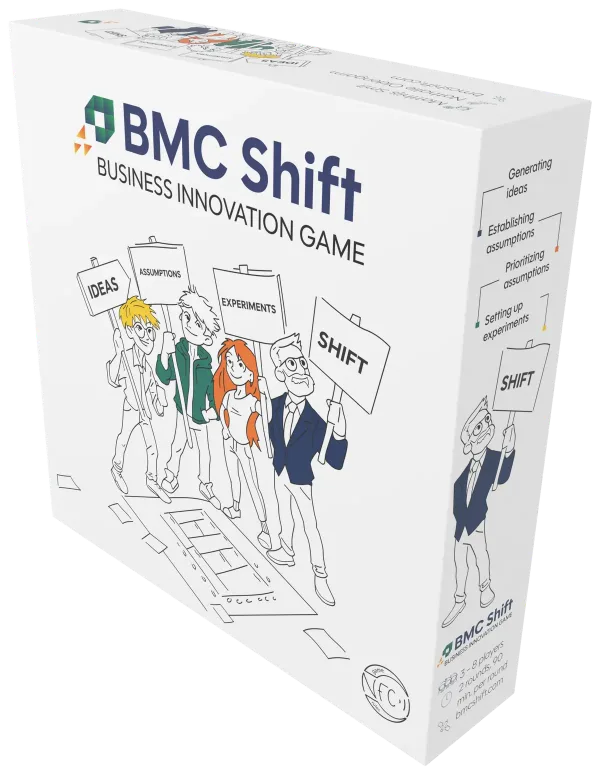
The BMC Shift game box, the board game with the Business Model Canvas

Questions about Nespresso’s business model

What is Nespresso’s business model?

The razor-and-blades model. The machine is relatively cheap, and the profit comes from the capsules customers buy again and again. A closed system and direct contact with the customer keep those customers loyal.

How does Nespresso make money?

Mainly by selling capsules to home drinkers and businesses, through the webshop, the app and its own boutiques. It also earns from machines, accessories and business contracts.

Why are Nespresso machines relatively cheap?

Because the machine is the entry to the system. A low price lowers the barrier to getting started, and the capsules that follow bring in the money.

May I use this example in class or in a workshop?

Yes. Open the example in the free canvas, edit it and download it as a PDF. When you use it, credit BMC Shift as the source and Strategyzer as the creator of the Business Model Canvas.

Sources

  1. Nestlé, Full-year results 2025 (19 February 2026): Nespresso revenue and organic growth.
  2. Nestlé Nespresso, Facts & figures: boutiques, countries and factories.
  3. Nespresso, What is Nespresso’s current global recycling rate?: recycling rate 2024.
  4. Osterwalder, A. and Pigneur, Y. (2010). Business Model Generation.
Matthijs Smit, founder and creator of BMC Shift
Matthijs Smit is the creator of BMC Shift and a lecturer in entrepreneurship at Hanze University of Applied Sciences. For about ten years he has trained teams, entrepreneurs and teachers in business innovation. LinkedIn

More examples

Freemium

Spotify

Free listening with ads as the shop window for Premium.

View the example ›
Mission

Tony’s Chocolonely

A mission that steers the whole canvas, from key partners to cost structure.

View the example ›

All Business Model Canvas examples