Apple sells premium devices and earns again on the same customer through services. The devices lock people into one ecosystem, and the ecosystem makes services such as iCloud, the App Store and Apple Pay easy to sell. In fiscal 2025 revenue was $416 billion, of which $109 billion came from services.
Read the canvas from right to left: first who Apple creates value for and how it earns from them, then what it takes behind the scenes to deliver that.
An iPhone, Mac or Watch is a premium-priced product in itself. It is also the way into the ecosystem: once someone has several Apple devices, switching gets harder.
More than 2.3 billion active devices give Apple a huge base to sell services to. Services reached $109 billion in fiscal 2025, about a quarter of revenue.
Apple designs chips, hardware and software together and runs its own stores and App Store. That makes products work smoothly and lets Apple set the rules for developers, including the commission.
Every filled-in canvas is a collection of assumptions. These are the three the Apple model depends on most, each with an experiment to test it.

Replacement cycles for phones and computers get longer. The model needs people to keep buying new devices and to stay with Apple instead of switching.
How to test it: track per cohort how long customers keep a device, and how many leave the ecosystem within three years.
Services is a quarter of revenue. App Store commissions and payments for default search are under pressure from regulators and courts.
How to test it: model the services revenue under a lower commission and without default payments, and see how much profit remains.
Apple builds almost everything with partners in a small number of countries and relies on a few chip makers. Trade rules and tensions can disrupt supply or raise costs.
How to test it: map for each product which factories and which chip supplier it depends on, and what moving 20% of production would cost.
Apple moved from a device maker to a company that also earns on services. New moves such as AI features and a more personal Siri change key resources and partners. Google even said it is working with Apple on the next generation of Apple Foundation Models, based on Gemini technology.

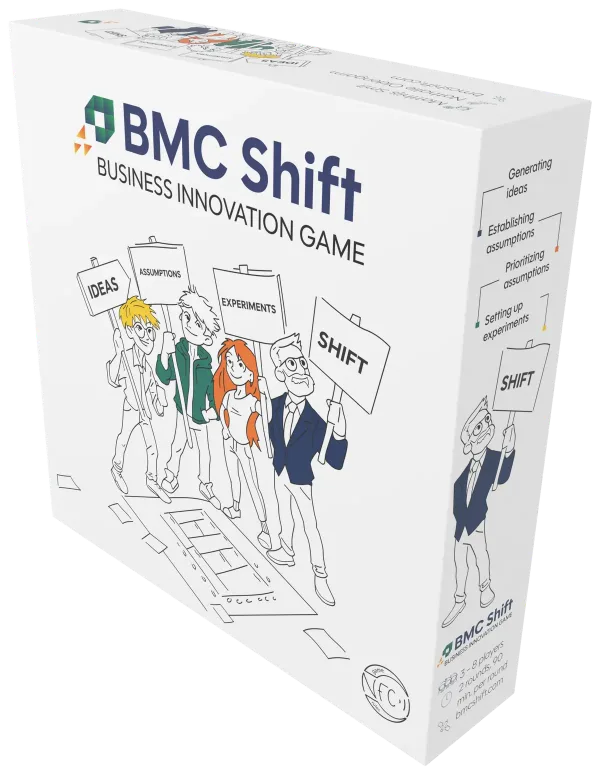
With BMC Shift your team comes up with new ideas, exposes the riskiest assumptions and designs experiments, around one game board. Played by more than 1,000 people in vocational education, universities of applied sciences, universities and strategy teams.
Apple designs premium devices such as the iPhone, Mac and iPad and sells them with its own software. Customers stay in the Apple ecosystem, where Apple earns again on services such as iCloud, Apple Music, the App Store and Apple Pay.
Mainly from device sales, with the iPhone as the largest product, and from services. In fiscal 2025 total revenue was $416 billion and services were $109 billion.
The set of devices, software and services that work best together, such as iPhone, Mac, Apple Watch, iCloud and AirPods. It raises the cost of switching to another brand, which is a form of lock-in.
Yes. Open the example in the free canvas, edit it and download it as a PDF. When you use it, credit BMC Shift as the source and Strategyzer as the creator of the Business Model Canvas.