Business Model Canvas example: Spotify

Spotify makes money with a freemium model. Anyone can listen for free with ads. People who want no ads and offline listening pay for Premium. At the end of 2025 Spotify had 751 million monthly users, of whom 290 million were paying. The biggest cost is the money that goes to artists, labels and publishers.

Freemium · Music and audio · Updated November 2026

751M
monthly users (end of 2025)
290M
paying Premium subscribers (end of 2025)
39%
of users pay (290 of 751 million)
33.1%
gross margin in Q4 2025: the rest of revenue goes to cost of revenue

The Business Model Canvas of Spotify

Read the canvas from right to left: first who Spotify creates value for and how it earns from them, then what it takes behind the scenes to deliver that.

Key Partners

  • Record labels and music publishers
  • Artists, podcast creators and authors
  • Telecom providers and hardware brands
  • Advertisers

Key Activities

  • Negotiating licenses with labels and publishers
  • Developing the app and algorithm
  • Converting free users to Premium
  • Selling advertising

Key Resources

  • Licenses for music and other content
  • Recommendation algorithm and listening data
  • Technology platform
  • Brand and user base

Value Propositions

  • Listeners: music, podcasts and audiobooks on every device
  • Personal recommendations such as Discover Weekly and Wrapped
  • Premium: no ads, offline listening, unlimited skips
  • Creators: reach and listening data
  • Advertisers: audiences based on listening behavior

Customer Relationships

  • Fully automated and personal
  • Free tier as the entry to Premium
  • Trial periods and discounts

Channels

  • App on phone, desktop, car, speakers and consoles
  • Partnerships with telecom and hardware brands
  • Sharing on social media (Wrapped)

Customer Segments

  • Free listeners (with ads)
  • Premium subscribers: Individual, Duo, Family, Student
  • Artists, podcast creators and authors
  • Advertisers

Cost Structure

  • Royalties to rights holders (biggest cost)
  • Technology and development
  • Marketing
  • Staff

Revenue Streams

  • Premium subscriptions (by far the largest share)
  • Advertising in the free tier and in podcasts
Filled in by BMC Shift based on public sources. Business Model Canvas: Strategyzer AG, CC BY-SA 3.0.Edit this canvas and download as PDF

Why Spotify’s freemium model works

Free is the shop window

The free tier costs Spotify money, but it brings in a huge number of listeners. They get to know the app and some of them upgrade to Premium. Without a free tier, Spotify would have to spend far more on marketing to win the same subscribers.

Two sides, three customers

Spotify serves listeners, creators and advertisers at the same time. The more listeners, the more interesting the platform is for creators and advertisers. The more content, the more interesting it is for listeners. That is a platform model on top of a subscription model.

Data makes the product better

Every song played feeds the recommendation algorithm. Better recommendations keep listeners around, and Wrapped gets them to post about it in huge numbers every year. That turns a key resource (listening data) into a channel as well.

The three riskiest assumptions behind this canvas

Every filled-in canvas is a collection of assumptions. These are the three the Spotify model depends on most, each with an experiment to test it.

The Assumptions character of BMC Shift
Desirability

Free listeners want to start paying

The model leans on the switch from free to Premium. If the free tier gets too good, the reason to pay disappears.

How to test it: give a group of free users an extra feature and measure whether their switch to Premium goes down or up.

Viability

Subscribers accept higher prices

Royalties rise with revenue. Making a margin only works if subscribers swallow a price increase without cancelling in large numbers.

How to test it: raise the price in a few countries first and compare the cancellation rate with countries without an increase.

Feasibility

Labels keep licensing their music

Without the catalogs of the big labels there is no Spotify. The company depends on a handful of partners who also talk to its competitors.

How to test it: map out per label what percentage of listening depends on it and when its contracts expire.

Shift question: what if you change one building block?

Spotify has been shifting its model for years. To depend less on record labels it added podcasts (acquiring Gimlet and Anchor in 2019) and, since 2023, audiobooks in Premium. That changes the key partners, key resources and cost structure at the same time.

The Shift character of BMC Shift

Discuss with your team or class

  • What happens to the revenue streams if Spotify scraps the free tier?
  • Which building blocks change if artists start selling directly to fans through Spotify?
  • What if an AI service creates endless new music without royalties?

What you learn for your own canvas

  • Split customer segments when they get or pay something different.
  • Write a separate value proposition for each segment.
  • Find your biggest cost and ask yourself who has power over it.

A filled-in canvas is only the beginning

With BMC Shift your team comes up with new ideas, exposes the riskiest assumptions and designs experiments, around one game board. Played by more than 1,000 people in vocational education, universities of applied sciences, universities and strategy teams.
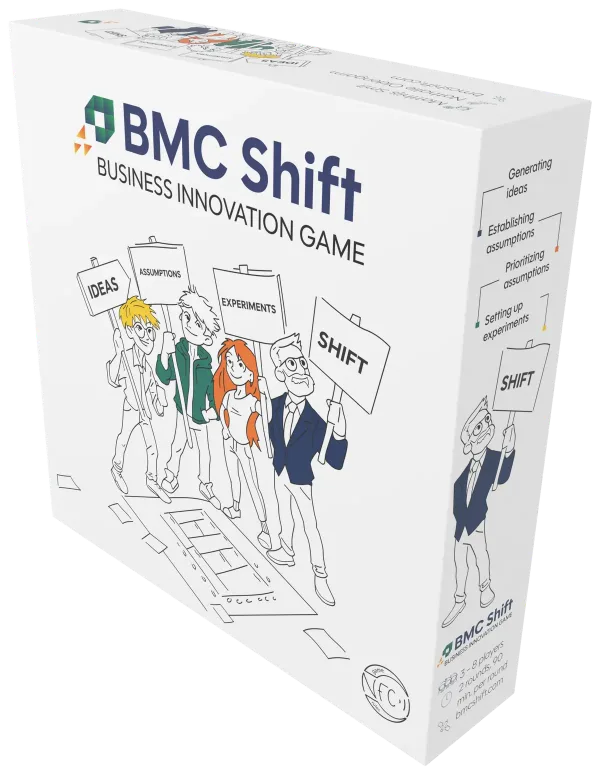
The BMC Shift game box, the board game with the Business Model Canvas

Questions about Spotify’s business model

What is Spotify’s business model?

Spotify has a freemium model. Listening is free with ads, and paying Premium subscribers get extras such as no ads and offline listening. Premium subscriptions bring in by far the largest share of revenue.

How does Spotify make money?

In two ways: with subscriptions (Individual, Duo, Family and Student) and with advertising in the free tier and in podcasts.

What is Spotify’s biggest cost?

The payments to rights holders: labels, publishers and artists. Spotify reported that it paid out more than $11 billion to the music industry in 2025. That is why its gross margin is relatively low (33.1 percent in the fourth quarter of 2025).

May I use this example in class or in a workshop?

Yes. Open the example in the free canvas, edit it and download it as a PDF. When you use it, credit BMC Shift as the source and Strategyzer as the creator of the Business Model Canvas.

Sources

  1. Spotify, Spotify Reports Fourth Quarter 2025 Earnings (10 February 2026): users, subscribers, revenue and gross margin.
  2. Spotify, Q4 2025 news overview: payouts to the music industry in 2025.
  3. Osterwalder, A. and Pigneur, Y. (2010). Business Model Generation.
Matthijs Smit, founder and creator of BMC Shift
Matthijs Smit is the creator of BMC Shift and a lecturer in entrepreneurship at Hanze University of Applied Sciences. For about ten years he has trained teams, entrepreneurs and teachers in business innovation. LinkedIn

More examples

Subscription + shift

Netflix

From DVDs by mail to streaming: two canvases side by side.

View the example ›
Platform

Airbnb

A platform without rooms of its own, with trust as its most important key resource.

View the example ›

All Business Model Canvas examples