Business Model Canvas example: Tony’s Chocolonely

Tony’s Chocolonely did not start as a chocolate brand, but as a campaign. Journalist Teun van de Keuken founded it in 2005 to tackle exploitation in the cocoa chain. That mission shapes every building block: which farmers supply, what price they get, why the bar is divided unevenly and even which competitors become partners. In the 2024/25 financial year revenue was 240 million euros.

Mission-driven · Food · Updated November 2026

€240M
revenue in the 2024/25 financial year, 20% growth
27,000
tonnes of cocoa beans (nearly) all bought through Tony’s Open Chain
30,000+
cocoa farmers in Ghana and Ivory Coast
<5%
child labour at regular partner cooperatives, against an industry average of 46.7%

The Business Model Canvas of Tony’s Chocolonely

In a mission-driven model the mission does not sit in one box. It determines which partners you choose, what your sourcing costs and why customers buy your bar. So read the left side just as carefully as the right side.

Key Partners

  • 19 partner cooperatives in Ghana and Ivory Coast
  • Production partner in Belgium
  • Mission Allies of Tony’s Open Chain
  • Supermarkets and retailers
  • NGOs and researchers

Key Activities

  • Buying cocoa according to the 5 sourcing principles
  • Running campaigns and building the brand
  • Developing new flavors and products
  • Measuring and reporting impact
  • Expanding Tony’s Open Chain

Key Resources

  • The mission and the brand
  • Direct relationships with cooperatives
  • Fully traceable cocoa chain
  • Team and community of fans

Value Propositions

  • Chocolate without exploitation, with traceable beans
  • Striking flavors and an unevenly divided bar with a story
  • A brand that draws customers to the chocolate shelf
  • A ready-made fair cocoa chain

Customer Relationships

  • Campaigns that fans take part in
  • Fans who spread the story
  • Long-term cooperation with retailers
  • Partnership as a Mission Ally

Channels

  • Supermarkets and other stores
  • Own webshop and store
  • Packaging and the bar as a message
  • Campaigns, press and the annual FAIR Report
  • The Tony’s Open Chain team

Customer Segments

  • Chocolate lovers who buy consciously
  • Supermarkets and retailers
  • Brands and companies that want to buy fair cocoa

Cost Structure

  • Cocoa at a higher price (biggest item)
  • Production and logistics
  • Marketing and campaigns
  • Impact programs and Open Chain

Revenue Streams

  • Sales of bars and other products through retail
  • Own webshop and store
  • Contributions from Mission Allies to Tony’s Open Chain
Filled in by BMC Shift based on public sources. Business Model Canvas: Strategyzer AG, CC BY-SA 3.0.Edit this canvas and download as PDF

Why Tony’s Chocolonely’s mission-driven model works

The mission is the brand

Tony’s needs to explain little in advertising. The unevenly divided bar and the bright packaging tell the story themselves. Customers buy chocolate, but also a point of view.

A higher price is a choice

Tony’s deliberately pays farmers more and signs contracts for years. That squeezes the margin: operating profit in 2024/25 was only 0.2 million euros. But it delivers reliable supply and a credible brand.

Competitors become partners

Through Tony’s Open Chain other brands and supermarkets can use the same fair sourcing. That makes the impact grow faster than Tony’s could ever sell on its own, and those partners contribute to the cost.

The three riskiest assumptions behind this canvas

Every filled-in canvas is a collection of assumptions. These are the three the Tony’s Chocolonely model depends on most, each with an experiment to test it.
The Assumptions character of BMC Shift
Desirability

Customers pay more for fair chocolate, even when cocoa is expensive

When cocoa prices are high, the price of every bar goes up. The model assumes customers keep choosing fair.

How to test it: after a price increase, compare Tony’s sales with those of regular brands on the same shelf and in the same stores.

Viability

The higher sourcing price fits within a healthy margin

With an operating profit of 0.2 million euros on 240 million in revenue there is little room for setbacks.

How to test it: calculate per bar what 20 percent more expensive cocoa does to the margin, and at which selling price the model makes a profit again.

Feasibility

Other companies want to join Tony’s Open Chain

The mission only scales if big brands and supermarkets also start buying through the five sourcing principles.

How to test it: measure how many approached companies sign a letter of intent after a conversation, and note what holds the rest back.

Shift question: what if you change one building block?

Tony’s is shifting from chocolate brand to movement. With Tony’s Open Chain it also sells its way of sourcing to other companies, such as Waitrose and Colruyt. And in 2024/25 the United States became its largest market for the first time, bigger than the Netherlands. That changes the customer segments, channels and key partners.
The Shift character of BMC Shift

Discuss with your team or class

  • What happens to the canvas if Tony’s only offers Open Chain and no longer sells bars itself?
  • How does the canvas change once the mission is achieved and all chocolate is fair?
  • What if a big competitor copies the unevenly divided bar?

What you learn for your own canvas

  • Do not put your mission in one box. Look at what the mission changes in every building block.
  • Make your higher costs visible and explain why your customer pays for them.
  • Ask yourself whether a competitor could also be a key partner or customer.

A filled-in canvas is only the beginning

With BMC Shift your team comes up with new ideas, exposes the riskiest assumptions and designs experiments, around one game board. Played by more than 1,000 people in vocational education, universities of applied sciences, universities and strategy teams.
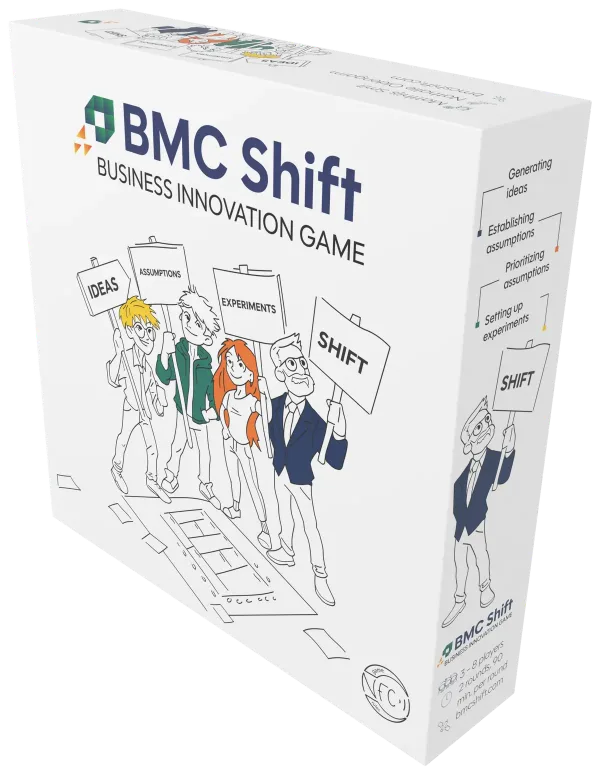
The BMC Shift game box, the board game with the Business Model Canvas

Questions about Tony’s Chocolonely’s business model

What is Tony’s Chocolonely’s business model?

A mission-driven brand model. Tony’s sells chocolate through supermarkets and its own channels, with the goal of ending exploitation in the cocoa chain. That mission determines sourcing, the brand and the partners.

How does Tony’s Chocolonely make money?

Mainly by selling chocolate through supermarkets and other stores. It also earns through its own webshop and store, and from contributions by companies that source through Tony’s Open Chain.

Is Tony’s Chocolonely profitable?

Just. In the 2024/25 financial year operating profit was 0.2 million euros on revenue of 240 million euros, about 3 million euros better than the year before. The higher cocoa price that Tony’s pays keeps the margin low.

May I use this example in class or in a workshop?

Yes. Open the example in the free canvas, edit it and download it as a PDF. When you use it, credit BMC Shift as the source and Strategyzer as the creator of the Business Model Canvas.

Sources

  1. Retail Times, Tony’s Chocolonely reports net revenue, volume and profitability growth (4 February 2026): revenue, operating profit, cocoa bought, farmers, cooperatives and child labour.
  2. Snack and Bakery, Tony’s Chocolonely reports double-digit growth (4 February 2026): the US as the largest market.
  3. RetailDetail, Tony’s Chocolonely doubles US sales (4 February 2025): Waitrose and Colruyt in Tony’s Open Chain.
  4. Osterwalder, A. and Pigneur, Y. (2010). Business Model Generation.
Matthijs Smit, founder and creator of BMC Shift
Matthijs Smit is the creator of BMC Shift and a lecturer in entrepreneurship at Hanze University of Applied Sciences. For about ten years he has trained teams, entrepreneurs and teachers in business innovation. LinkedIn

More examples

Platform

Airbnb

A platform without rooms of its own, with trust as its most important key resource.

View the example ›
Lock-in

Nespresso

Razor and blades: the machine opens the door, the capsules bring in the revenue.

View the example ›

All Business Model Canvas examples