Business Model Canvas example: Apple

Apple sells premium devices and earns again on the same customer through services. The devices lock people into one ecosystem, and the ecosystem makes services such as iCloud, the App Store and Apple Pay easy to sell. In fiscal 2025 revenue was $416 billion, of which $109 billion came from services.

Ecosystem lock-in · Devices and services · Updated November 2026

$416B
revenue in fiscal 2025
$109B
services revenue in fiscal 2025
2.3B+
active Apple devices in use
1B+
paid subscriptions

The Business Model Canvas of Apple

Read the canvas from right to left: first who Apple creates value for and how it earns from them, then what it takes behind the scenes to deliver that.

Key Partners

  • Contract manufacturers such as Foxconn
  • Chip makers such as TSMC
  • App developers
  • Carriers and retailers

Key Activities

  • Designing hardware, chips and software together
  • Running the App Store and services
  • Managing the global supply chain
  • Retail, marketing and support
  • Privacy and security engineering

Key Resources

  • Brand and loyal customer base
  • Own chips and operating systems
  • 2.3 billion active devices
  • Apple Stores and ecosystem

Value Propositions

  • Device buyers: well-designed devices that work together
  • Services users: iCloud, Music, TV and Apple Pay in one ecosystem
  • Developers: a rich customer base and tools to reach it
  • Businesses and schools: managed devices and security
  • Privacy and security as a selling point

Customer Relationships

  • Apple Store and support
  • Seamless ecosystem that is hard to leave
  • Self-service App Store
  • Business teams and education programmes

Channels

  • Apple Stores and online store
  • Carriers and retailers
  • App Store and services inside the devices
  • Business and education sales

Customer Segments

  • Device buyers: iPhone, Mac, iPad, Watch
  • Services users and subscribers
  • App developers
  • Businesses and schools

Cost Structure

  • Components and manufacturing (cost of sales)
  • Research and software development
  • Retail stores and marketing
  • Staff and services infrastructure

Revenue Streams

  • Device sales: iPhone, Mac, iPad, Wearables
  • Services subscriptions: iCloud, Music, TV+
  • App Store commissions
  • AppleCare and Apple Pay
  • Business and education sales
Filled in by BMC Shift based on public sources. Business Model Canvas: Strategyzer AG, CC BY-SA 3.0.Edit this canvas and download as PDF

Why Apple’s ecosystem works

Devices open the door

An iPhone, Mac or Watch is a premium-priced product in itself. It is also the way into the ecosystem: once someone has several Apple devices, switching gets harder.

Services earn on the installed base

More than 2.3 billion active devices give Apple a huge base to sell services to. Services reached $109 billion in fiscal 2025, about a quarter of revenue.

One company controls the whole stack

Apple designs chips, hardware and software together and runs its own stores and App Store. That makes products work smoothly and lets Apple set the rules for developers, including the commission.

The three riskiest assumptions behind this canvas

Every filled-in canvas is a collection of assumptions. These are the three the Apple model depends on most, each with an experiment to test it.

The Assumptions character of BMC Shift
Desirability

Customers keep upgrading and stay in the ecosystem

Replacement cycles for phones and computers get longer. The model needs people to keep buying new devices and to stay with Apple instead of switching.

How to test it: track per cohort how long customers keep a device, and how many leave the ecosystem within three years.

Viability

Services keep growing despite regulation

Services is a quarter of revenue. App Store commissions and payments for default search are under pressure from regulators and courts.

How to test it: model the services revenue under a lower commission and without default payments, and see how much profit remains.

Feasibility

Production stays possible in a few places

Apple builds almost everything with partners in a small number of countries and relies on a few chip makers. Trade rules and tensions can disrupt supply or raise costs.

How to test it: map for each product which factories and which chip supplier it depends on, and what moving 20% of production would cost.

Shift question: what if you change one building block?

Apple moved from a device maker to a company that also earns on services. New moves such as AI features and a more personal Siri change key resources and partners. Google even said it is working with Apple on the next generation of Apple Foundation Models, based on Gemini technology.

The Shift character of BMC Shift

Discuss with your team or class

  • What happens to the revenue streams if the App Store commission is cut in half?
  • Which building blocks change if AI assistants make the choice of phone less important?
  • What if Apple offers its services on other platforms too?

What you learn for your own canvas

  • Lock-in works best when the second product builds on the first.
  • A recurring revenue stream on top of a one-time sale changes how you value a customer.
  • Check which building blocks others can regulate or switch off.

A filled-in canvas is only the beginning

With BMC Shift your team comes up with new ideas, exposes the riskiest assumptions and designs experiments, around one game board. Played by more than 1,000 people in vocational education, universities of applied sciences, universities and strategy teams.
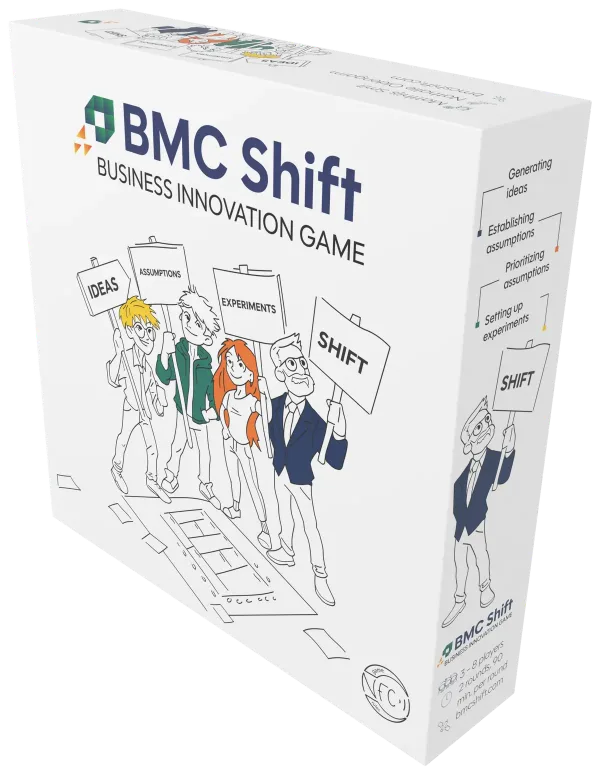
The BMC Shift game box, the board game with the Business Model Canvas

Questions about Apple’s business model

What is Apple’s business model?

Apple designs premium devices such as the iPhone, Mac and iPad and sells them with its own software. Customers stay in the Apple ecosystem, where Apple earns again on services such as iCloud, Apple Music, the App Store and Apple Pay.

How does Apple make money?

Mainly from device sales, with the iPhone as the largest product, and from services. In fiscal 2025 total revenue was $416 billion and services were $109 billion.

What is the Apple ecosystem?

The set of devices, software and services that work best together, such as iPhone, Mac, Apple Watch, iCloud and AirPods. It raises the cost of switching to another brand, which is a form of lock-in.

May I use this example in class or in a workshop?

Yes. Open the example in the free canvas, edit it and download it as a PDF. When you use it, credit BMC Shift as the source and Strategyzer as the creator of the Business Model Canvas.

Sources

  1. Apple, Apple reports fourth quarter results (30 October 2025): revenue and installed base.
  2. Constellation Research, Apple’s annual services revenue tops $109 billion (30 October 2025).
  3. Statista, Apple services revenue: active devices and paid subscriptions.
  4. Alphabet, Q4 2025 earnings remarks from Sundar Pichai: collaboration with Apple.
  5. Osterwalder, A. and Pigneur, Y. (2010). Business Model Generation.
Matthijs Smit, founder and creator of BMC Shift
Matthijs Smit is the creator of BMC Shift and a lecturer in entrepreneurship at Hanze University of Applied Sciences. For about ten years he has trained teams, entrepreneurs and teachers in business innovation. LinkedIn

More examples

Direct sales + software

Tesla

Cars as the entry point, with software, energy and charging on top.

View the example ›
Lock-in

Nespresso

The machine opens the door and the capsules generate the revenue.

View the example ›

All Business Model Canvas examples