Business Model Canvas example: Netflix

Netflix started in 1998 renting DVDs by mail and is now a streaming service with more than 325 million paid memberships and $45.2 billion in revenue in 2025. Netflix is the textbook case of a company that shifts its own business model before a competitor does it for them. Below you see both canvases side by side.

Subscription · Shift from DVD to streaming · Updated November 2026

325M+
paid memberships (end of 2025)
$45.2B
revenue in 2025, 16% more than in 2024
$1.5B+
advertising revenue in 2025, more than 2.5 times as much as in 2024
29.5%
operating margin in 2025

The Business Model Canvas of Netflix: then and now

Compare the canvas from the DVD era with today’s canvas. The value proposition looks alike (watch a lot for a fixed price), but almost every other building block has shifted.

Key Partners

  • Production companies and creators
  • Studios and licensors
  • Internet providers and TV brands
  • Advertisers

Key Activities

  • Producing and buying content
  • Developing the app and recommendations
  • Building advertising technology
  • Global marketing

Key Resources

  • Original content and intellectual property
  • Streaming technology and own network (Open Connect)
  • Viewing data and recommendation algorithm
  • Brand

Value Propositions

  • Series, films, live events and games on every screen
  • Originals you cannot get anywhere else
  • No contract: cancel monthly
  • Cheaper plan with ads
  • Advertisers: reach among engaged viewers

Customer Relationships

  • Personal recommendations and profiles
  • Self-service, no contact needed

Channels

  • App on smart TV, phone, tablet and browser
  • Deals with telecom providers and TV brands
  • Social media and word of mouth

Customer Segments

  • Households worldwide (more than 325 million paid memberships)
  • Price-conscious viewers (ad-supported plan)
  • Advertisers

Cost Structure

  • Content (by far the biggest cost)
  • Technology and development
  • Marketing
  • Staff

Revenue Streams

  • Subscriptions: Standard with ads, Standard, Premium
  • Extra member outside the household
  • Advertising
Filled in by BMC Shift based on public sources. Business Model Canvas: Strategyzer AG, CC BY-SA 3.0.Edit this canvas and download as PDF

From DVD to streaming: building block by building block

The customer still pays a fixed amount per month. But the way Netflix delivers that value has been turned completely upside down.

Building block2005: DVD by mailNow: streaming
ChannelsWebsite and mailApp on every screen
Key ResourcesDVD inventory and distribution centersOriginal content, technology and viewing data
Key PartnersStudios and the postal serviceProduction companies, internet providers and advertisers
Customer SegmentsFilm fans in the USHouseholds worldwide plus advertisers
Revenue StreamsOne monthly subscriptionMultiple plans, extra members and advertising
Cost StructureDVDs, postage and logisticsMaking and buying content
  1. 1997Netflix is founded in California; in 1998 the DVD-by-mail rental goes online.
  2. 1999Monthly subscription with no late fees.
  3. 2007Streaming launches, first as an extra with the DVD subscription.
  4. 2011Netflix wants to split off the DVD business under the name Qwikster and raises prices. Customers leave and the plan is withdrawn within a month.
  5. 2013House of Cards: the first major original series. Netflix launches in the Netherlands.
  6. 2016Available in almost every country.
  7. 2022Cheaper plan with ads.
  8. 2023Paid sharing outside the household. The DVD service shuts down.
  9. 2025More than 325 million paid memberships and more than $1.5 billion in advertising revenue.

The three riskiest assumptions behind today’s canvas

Netflix’s current model stands or falls with these three assumptions. For each one there is an experiment to test it.

The Assumptions character of BMC Shift
Desirability

Viewers stay for original content

There are many streaming services. Netflix assumes its own series and films are reason enough to stay a member, even after the series you came for.

How to test it: measure how many members cancel in the month after a major original series ends.

Viability

Advertising makes the cheaper plan profitable

The ad-supported plan is cheaper. That only works if advertising makes up the difference in revenue per member. Netflix itself calls closing that gap a priority.

How to test it: compare total revenue per member (subscription plus advertising) of both plans per country.

Feasibility

Netflix makes enough hits every year

Original content is expensive and success is hard to predict. The model needs a constant stream of series and films that people talk about.

How to test it: put cost next to viewing hours and new members for each production, and see what share pays for itself.

The lesson from Netflix: shift before you have to

Netflix started streaming while the DVD business was still doing fine, and so ate into its own revenue. Qwikster also shows what goes wrong when you push through a shift without taking the customer relationship along: the same change, but too fast and with a price increase, cost it customers.
The Shift character of BMC Shift

Discuss with your team or class

  • Which building block of your own model is like Netflix’s DVD inventory: valuable now, but a burden later?
  • What if Netflix only offered a plan with ads?
  • What changes if Netflix makes live sports the core of its offering?

What you learn for your own canvas

  • An unchanged value proposition can have a completely different back end.
  • Draw your model of today next to your model in five years.
  • With every shift, look at the customer relationship, not just the technology.

Practise the shift with your own team

In BMC Shift your team goes through the same steps as Netflix: coming up with ideas, exposing assumptions, designing experiments and shifting the business model. Around one game board, with 3 to 8 players. Played by more than 1,000 people.
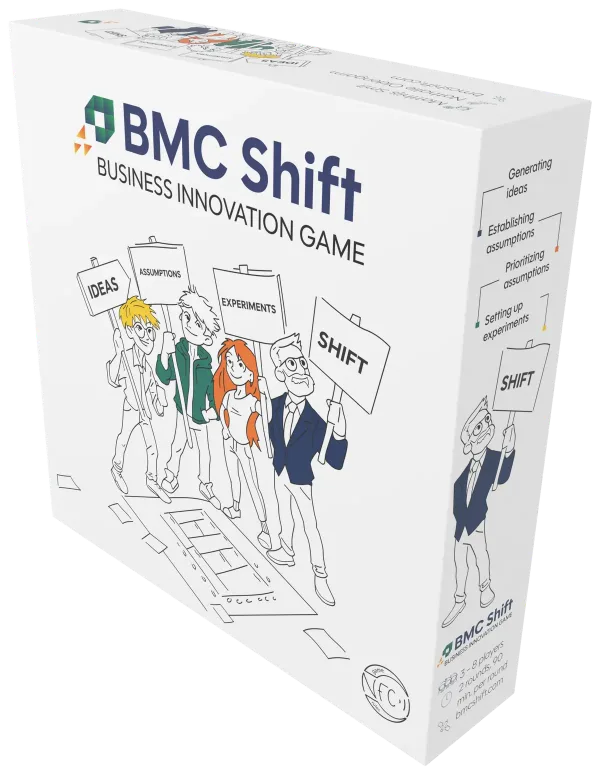
The BMC Shift game box, the board game with the Business Model Canvas

Questions about Netflix’s business model

What is Netflix’s business model?

Netflix has a subscription model. Members pay monthly for unlimited viewing, and since 2022 there is a cheaper plan with ads. That makes advertising a second revenue stream.

How has Netflix’s business model changed?

Netflix started with DVD rental by mail and switched to streaming from 2007. It then started making its own content and expanded internationally. The DVD service stopped in 2023.

How does Netflix make money?

With subscriptions, payments for extra members outside the household and advertising. In 2025 revenue was $45.2 billion, of which more than $1.5 billion came from advertising.

May I use this example in class or in a workshop?

Yes. Open either canvas in the free canvas tool, edit it and download it as a PDF. When you use it, credit BMC Shift as the source and Strategyzer as the creator of the Business Model Canvas.

Sources

  1. Netflix, Q4 2025 Shareholder Letter (20 January 2026): revenue, memberships, advertising revenue and margin.
  2. Marketing Dive, Netflix targets $3B in ad revenue: revenue per member of the ad-supported plan.
  3. Osterwalder, A. and Pigneur, Y. (2010). Business Model Generation.
Matthijs Smit, founder and creator of BMC Shift
Matthijs Smit is the creator of BMC Shift and a lecturer in entrepreneurship at Hanze University of Applied Sciences. For about ten years he has trained teams, entrepreneurs and teachers in business innovation. LinkedIn

More examples

Freemium

Spotify

Free listening with ads as the shop window for Premium.

View the example ›
Platform

Airbnb

A platform without rooms of its own, with trust as its most important key resource.

View the example ›

All Business Model Canvas examples