Business Model Canvas example: Google

Google gives its main products away for free and earns from the advertisers who want to reach those users. That is an advertising model with a free side and a paying side. In 2025 Alphabet’s revenue passed $400 billion for the first time, and in the fourth quarter advertising was 72% of it.

Advertising model · Search and AI · Updated November 2026

$400B+
Alphabet revenue in 2025, a first
72%
of Q4 2025 revenue came from advertising
325M
paid subscriptions, led by Google One and YouTube Premium
48%
growth of Google Cloud revenue in Q4 2025

The Business Model Canvas of Google

Read the canvas from right to left: first who Google creates value for and how it earns from them, then what it takes behind the scenes to deliver that.

Key Partners

  • Phone and browser makers that set Google as default
  • Websites and publishers in the ad network
  • YouTube creators
  • Chip, server and energy suppliers

Key Activities

  • Improving search and AI answers
  • Running the ad auction and ad tools
  • Building and running Google Cloud
  • Developing Android, Chrome, YouTube and Gemini

Key Resources

  • Search index and the data behind it
  • Data centres and own AI chips (TPUs)
  • Brand and billions of daily users
  • AI research talent and the Gemini models

Value Propositions

  • Users: free, fast answers to almost any question
  • Advertisers: reach people while they are searching, pay per click
  • Cloud customers: infrastructure and AI models such as Gemini
  • Subscribers: no ads, extra storage and extra AI features

Customer Relationships

  • Free and fully automated
  • Self-service ad tools and measurement
  • Account teams for large customers
  • Subscriptions with trial periods

Channels

  • Search on the web, in Chrome and on Android
  • Google Ads and the ad network
  • Cloud sales teams and marketplace
  • Google Play, YouTube and Google One apps

Customer Segments

  • People who search and use free Google products
  • Advertisers
  • Google Cloud customers
  • Subscribers: YouTube Premium and Google One

Cost Structure

  • Traffic acquisition costs: default deals and ad network partners
  • Data centres, chips and energy
  • Content costs for YouTube
  • Research, development and staff

Revenue Streams

  • Advertising on Search, YouTube and the network
  • Google Cloud usage fees
  • Subscriptions, apps and devices
  • Free users pay nothing
Filled in by BMC Shift based on public sources. Business Model Canvas: Strategyzer AG, CC BY-SA 3.0.Edit this canvas and download as PDF

Why Google’s advertising model works

Free for users, paid by advertisers

Searching is free, so billions of people use it. Advertisers pay when someone clicks. The user is the audience, the advertiser is the customer who pays.

Intent is the product

A search shows what someone wants right now. Ads next to that search are worth more than ads shown to people who are not looking. Search and other ads brought in $63.1 billion in the fourth quarter of 2025.

Defaults keep the flywheel turning

Google pays phone and browser makers to be the default search engine. In the fourth quarter these traffic acquisition costs were $16.6 billion. Defaults keep users coming, and data from those users makes search and ads better.

The three riskiest assumptions behind this canvas

Every filled-in canvas is a collection of assumptions. These are the three the Google model depends on most, each with an experiment to test it.

The Assumptions character of BMC Shift
Desirability

People keep starting with Google Search

The model needs searches to stay on Google. If people ask AI assistants instead of searching, there are fewer ad moments. Google answers this with AI Overviews and AI Mode.

How to test it: track for a group of users how many questions they ask a search engine versus an AI assistant, and how often they click an ad after an AI answer.

Viability

AI answers can carry as many ads as search results did

An AI answer replaces a list of links, so there is less room for ads. The model only holds if ads in AI answers earn as much per question as classic search ads.

How to test it: compare revenue per query for AI answers and classic results in a few markets, with the same set of advertisers.

Feasibility

Default deals stay allowed

Distribution deals with phone and browser makers drive a large part of search traffic. Courts and competition authorities have looked closely at these deals. Without defaults Google needs more marketing to keep its share.

How to test it: map per device maker which percentage of searches comes through a default and when each deal ends.

Shift question: what if you change one building block?

Google has been reducing its dependence on search ads for years. Google Cloud grew 48% in the fourth quarter of 2025 to $17.7 billion, and paid subscriptions such as YouTube Premium and Google One passed 325 million. That changes customer segments, revenue streams and cost structure at the same time.

The Shift character of BMC Shift

Discuss with your team or class

  • What happens to the revenue streams if AI answers replace most search results?
  • Which building blocks change if Google has to stop paying for default placement?
  • What would Google have to charge users to replace the advertising revenue?

What you learn for your own canvas

  • A free side can be paid for by another segment.
  • Name which segment is the customer and which is the audience.
  • Check what your model depends on that someone else controls.

A filled-in canvas is only the beginning

With BMC Shift your team comes up with new ideas, exposes the riskiest assumptions and designs experiments, around one game board. Played by more than 1,000 people in vocational education, universities of applied sciences, universities and strategy teams.
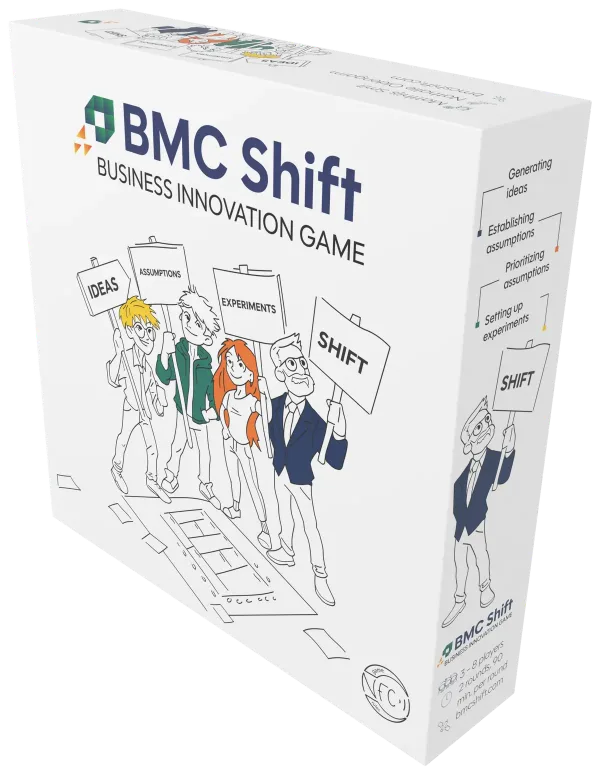
The BMC Shift game box, the board game with the Business Model Canvas

Questions about Google’s business model

What is Google’s business model?

Google gives products such as Search, Chrome, Maps and Gmail away for free and earns mainly from advertising. Advertisers pay to show ads to people who use those products. Besides that Google earns from Google Cloud and from subscriptions such as YouTube Premium and Google One.

How does Google make money?

Mostly through advertising on Search, YouTube and the ad network. In the fourth quarter of 2025 advertising brought in $82.3 billion of $113.8 billion total revenue. Google Cloud added $17.7 billion.

What is the difference between Google and Alphabet?

Alphabet is the parent company. Google Services, Google Cloud and Other Bets such as Waymo are its segments. This canvas describes the part that earns most: Search, YouTube, Cloud and subscriptions.

May I use this example in class or in a workshop?

Yes. Open the example in the free canvas, edit it and download it as a PDF. When you use it, credit BMC Shift as the source and Strategyzer as the creator of the Business Model Canvas.

Sources

  1. Alphabet, Q4 2025 earnings call (4 February 2026): revenue, Cloud growth, subscriptions and YouTube.
  2. Nasdaq, Alphabet’s Q4 earnings: share of advertising in revenue and Search and other revenue.
  3. AlphaSense, Alphabet Q4 2025 analysis: traffic acquisition costs.
  4. Osterwalder, A. and Pigneur, Y. (2010). Business Model Generation.
Matthijs Smit, founder and creator of BMC Shift
Matthijs Smit is the creator of BMC Shift and a lecturer in entrepreneurship at Hanze University of Applied Sciences. For about ten years he has trained teams, entrepreneurs and teachers in business innovation. LinkedIn

More examples

Subscription + usage-based

OpenAI

Free, paid, enterprise and API: one technology sold four ways.

View the example ›
Flywheel + platform

Amazon

A store, a marketplace, Prime, ads and AWS that feed each other.

View the example ›

All Business Model Canvas examples