Tony’s Chocolonely did not start as a chocolate brand, but as a campaign. Journalist Teun van de Keuken founded it in 2005 to tackle exploitation in the cocoa chain. That mission shapes every building block: which farmers supply, what price they get, why the bar is divided unevenly and even which competitors become partners. In the 2024/25 financial year revenue was 240 million euros.
In a mission-driven model the mission does not sit in one box. It determines which partners you choose, what your sourcing costs and why customers buy your bar. So read the left side just as carefully as the right side.
Tony’s needs to explain little in advertising. The unevenly divided bar and the bright packaging tell the story themselves. Customers buy chocolate, but also a point of view.
Tony’s deliberately pays farmers more and signs contracts for years. That squeezes the margin: operating profit in 2024/25 was only 0.2 million euros. But it delivers reliable supply and a credible brand.
Through Tony’s Open Chain other brands and supermarkets can use the same fair sourcing. That makes the impact grow faster than Tony’s could ever sell on its own, and those partners contribute to the cost.
Every filled-in canvas is a collection of assumptions. These are the three the Tony’s Chocolonely model depends on most, each with an experiment to test it.
When cocoa prices are high, the price of every bar goes up. The model assumes customers keep choosing fair.
How to test it: after a price increase, compare Tony’s sales with those of regular brands on the same shelf and in the same stores.
With an operating profit of 0.2 million euros on 240 million in revenue there is little room for setbacks.
How to test it: calculate per bar what 20 percent more expensive cocoa does to the margin, and at which selling price the model makes a profit again.
The mission only scales if big brands and supermarkets also start buying through the five sourcing principles.
How to test it: measure how many approached companies sign a letter of intent after a conversation, and note what holds the rest back.
Tony’s is shifting from chocolate brand to movement. With Tony’s Open Chain it also sells its way of sourcing to other companies, such as Waitrose and Colruyt. And in 2024/25 the United States became its largest market for the first time, bigger than the Netherlands. That changes the customer segments, channels and key partners.
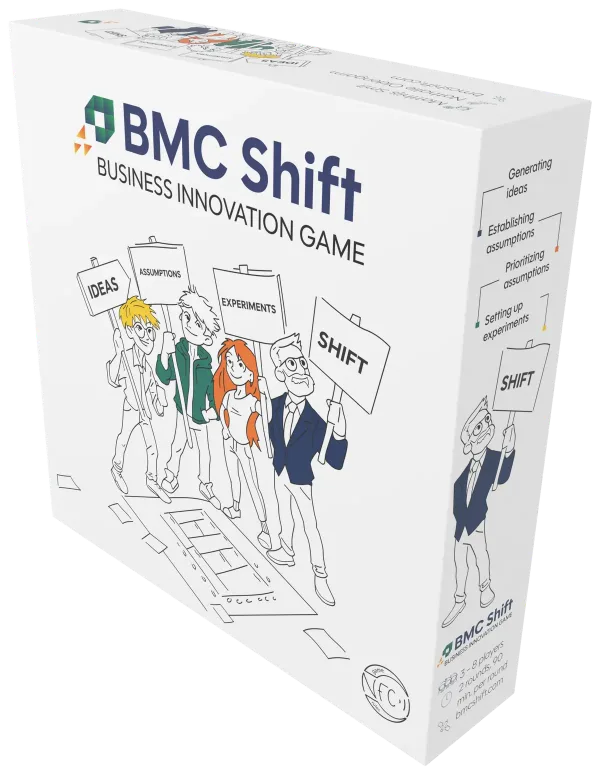
With BMC Shift your team comes up with new ideas, exposes the riskiest assumptions and designs experiments, around one game board. Played by more than 1,000 people in vocational education, universities of applied sciences, universities and strategy teams.
A mission-driven brand model. Tony’s sells chocolate through supermarkets and its own channels, with the goal of ending exploitation in the cocoa chain. That mission determines sourcing, the brand and the partners.
Mainly by selling chocolate through supermarkets and other stores. It also earns through its own webshop and store, and from contributions by companies that source through Tony’s Open Chain.
Just. In the 2024/25 financial year operating profit was 0.2 million euros on revenue of 240 million euros, about 3 million euros better than the year before. The higher cocoa price that Tony’s pays keeps the margin low.
Yes. Open the example in the free canvas, edit it and download it as a PDF. When you use it, credit BMC Shift as the source and Strategyzer as the creator of the Business Model Canvas.