Netflix started in 1998 renting DVDs by mail and is now a streaming service with more than 325 million paid memberships and $45.2 billion in revenue in 2025. Netflix is the textbook case of a company that shifts its own business model before a competitor does it for them. Below you see both canvases side by side.
Compare the canvas from the DVD era with today’s canvas. The value proposition looks alike (watch a lot for a fixed price), but almost every other building block has shifted.
The customer still pays a fixed amount per month. But the way Netflix delivers that value has been turned completely upside down.
| Building block | 2005: DVD by mail | Now: streaming |
|---|---|---|
| Channels | Website and mail | App on every screen |
| Key Resources | DVD inventory and distribution centers | Original content, technology and viewing data |
| Key Partners | Studios and the postal service | Production companies, internet providers and advertisers |
| Customer Segments | Film fans in the US | Households worldwide plus advertisers |
| Revenue Streams | One monthly subscription | Multiple plans, extra members and advertising |
| Cost Structure | DVDs, postage and logistics | Making and buying content |
Netflix’s current model stands or falls with these three assumptions. For each one there is an experiment to test it.

There are many streaming services. Netflix assumes its own series and films are reason enough to stay a member, even after the series you came for.
How to test it: measure how many members cancel in the month after a major original series ends.
The ad-supported plan is cheaper. That only works if advertising makes up the difference in revenue per member. Netflix itself calls closing that gap a priority.
How to test it: compare total revenue per member (subscription plus advertising) of both plans per country.
Original content is expensive and success is hard to predict. The model needs a constant stream of series and films that people talk about.
How to test it: put cost next to viewing hours and new members for each production, and see what share pays for itself.
Netflix started streaming while the DVD business was still doing fine, and so ate into its own revenue. Qwikster also shows what goes wrong when you push through a shift without taking the customer relationship along: the same change, but too fast and with a price increase, cost it customers.
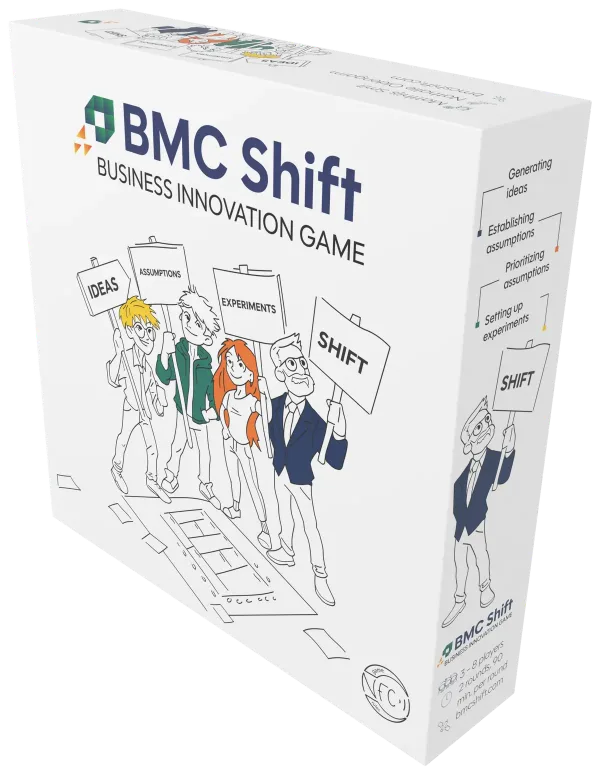
In BMC Shift your team goes through the same steps as Netflix: coming up with ideas, exposing assumptions, designing experiments and shifting the business model. Around one game board, with 3 to 8 players. Played by more than 1,000 people.
Netflix has a subscription model. Members pay monthly for unlimited viewing, and since 2022 there is a cheaper plan with ads. That makes advertising a second revenue stream.
Netflix started with DVD rental by mail and switched to streaming from 2007. It then started making its own content and expanded internationally. The DVD service stopped in 2023.
With subscriptions, payments for extra members outside the household and advertising. In 2025 revenue was $45.2 billion, of which more than $1.5 billion came from advertising.
Yes. Open either canvas in the free canvas tool, edit it and download it as a PDF. When you use it, credit BMC Shift as the source and Strategyzer as the creator of the Business Model Canvas.